

ECI RELATED DEVELOPMENTS
16.10.2026
During a recent field trip to Geneva, ECI Director Carsten Berg met with campaigners, researchers and political actors involved in an unusual democratic experiment that is still being fought for on the ground through a popular initiative for thematic citizens’ assemblies. The campaign must collect its signatures by 26 October 2026.
Nowhere else seems more fitting for this than Switzerland. Its citizens vote on local, cantonal and federal questions roughly every three months. Swiss direct voting processes on issues are associated with high levels of trust (OECD, 2024), and has long served as a reference point for democratic innovations, including the ECI.
Yet even here, democracy faces multiple pressures. Among them, a central question remains open: how can direct citizen power be combined with the deeper deliberation that complex political questions often require?
Citizens’ assemblies are one answer, and they have spread rapidly across Europe and beyond in what the OECD calls a “deliberative wave” (OECD 2020). However most remain largely advisory and fail to translate deliberation into real-world implementation. Political authorities generally decide both whether an assembly takes place and what, if anything, happens with its recommendations afterwards.
The Geneva proposal addresses both ends of this problem: who gets to initiate a citizens’ assembly – and what happens with its proposals afterwards?
Combining different democratic modes and strengths
Each democratic mode does something the others cannot. Citizens’ assemblies offer deep deliberation, but rarely binding influence. Direct democracy gives citizens agenda-setting and decision-making power and scales debate to millions, but seldom allows sustained in-depth deliberation. Elected institutions provide continuity and stable law-making capacity, yet leave citizens few openings between elections.
Seen this way, the three democratic modes – electoral, deliberative, and direct – need not be understood as competitors. The more compelling question is how these distinct capacities can be integrated within the same institutional process. This is precisely what makes Geneva such a compelling case: citizens can initiate a process, a randomly selected assembly deliberates and formulates proposals, elected representatives engage directly with these citizen recommendations, and – in the case of rejection by elected authorities – the wider electorate ultimately decides.
How the Geneva model works
The proposal provides two routes to a thematic citizens’ assembly.
A majority of Geneva’s elected Parliament, the Grand Council, could initiate an assembly on a specific issue. Alternatively – and more innovatively – citizens themselves could trigger one by collecting signatures from 2% of Geneva’s electorate, roughly 5,700 people.
In either case, 50 randomly selected residents, broadly reflecting the diversity of Geneva’s population, would examine the issue, hear different perspectives and formulate concrete proposals. These would then go to the Grand Council, which would have to respond. If Parliament rejects the proposals, a popular vote would follow, potentially alongside a parliamentary counter-proposal.
The assembly does not have the last word, and neither does Parliament: the electorate does.
This is what makes the proposal particularly noteworthy. Citizens gain a way of initiating not “merely” a popular initiative or a vote, but an in-depth deliberative process. At the other end, the assembly’s recommendations cannot simply disappear into a drawer. They enter a constitutionally defined process of political follow-up. Parliament nevertheless remains fully part of that process and retains the possibility of accepting, rejecting or responding with a counter-proposal.
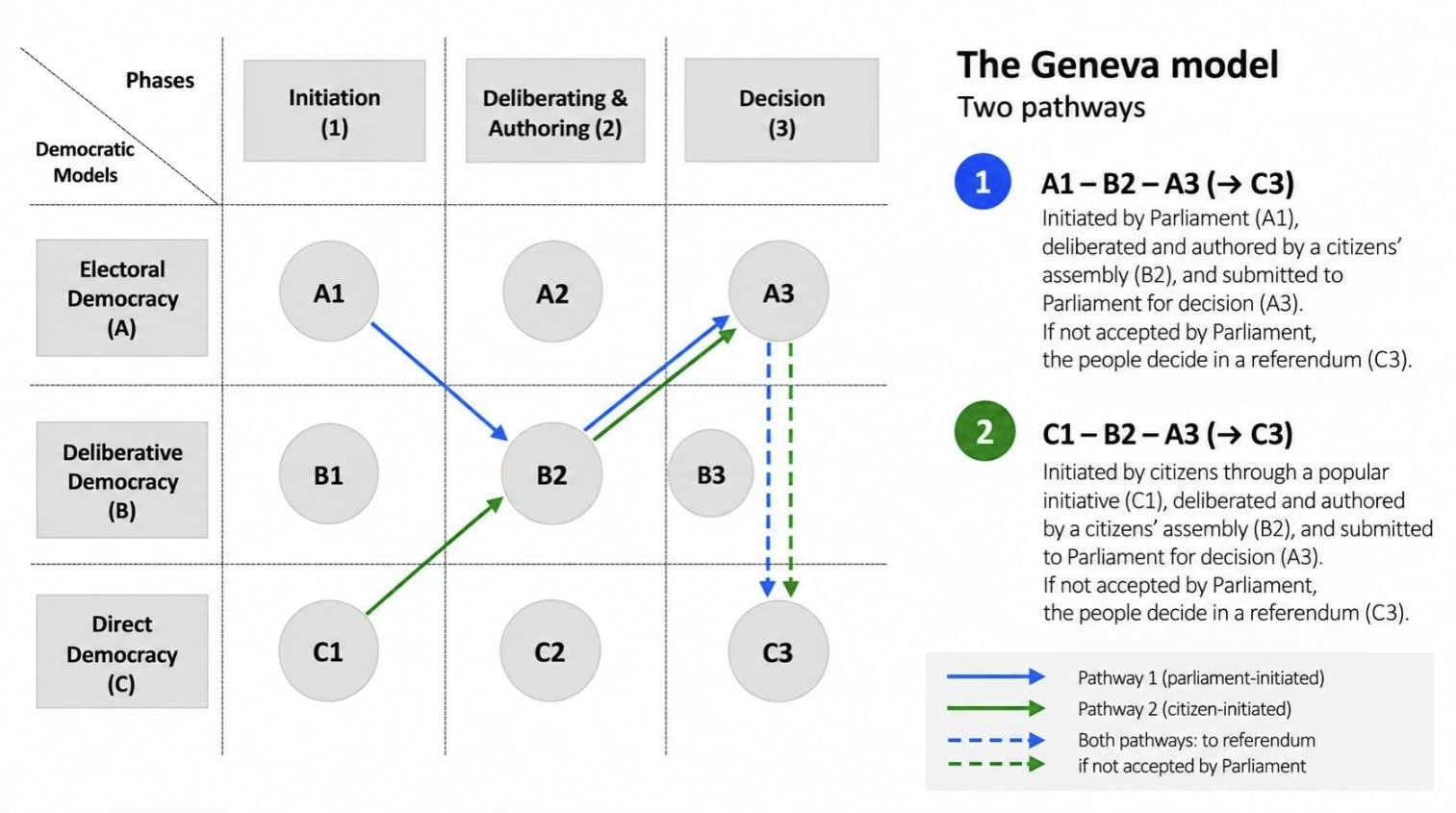
Figure: The Geneva model – electoral, deliberative and direct democracy across initiation, deliberation and decision
Why Geneva?
The initiative grew out of conflict. Earlier in 2026, Geneva’s Parliament, the Grand Council, cancelled a planned, government-backed citizens’ assembly on the future of democracy only weeks before it was due to begin, after critics questioned its mandate and legitimacy. Rather than abandoning the idea, a predominantly young group of citizens and civil-society activists around the NGO Déclic’démocratique launched the constitutional popular initiative For Thematic Citizens’ Assemblies. It does not seek to replace Geneva’s existing institutions, but to embed deliberation within an already powerful system of electoral and direct democracy.
Innovation in motion
Of course Geneva is not a proven model. It is an experiment still in the making. At the time of the field trip, the campaign was still collecting the signatures needed to move the initiative forward. If successful, the initiative could set in motion a political process involving the government, Parliament and the initiative committee, lasting up to two and a half years. Under the existing rules, the proposal could be accepted, amended, or met with a counter-proposal by Parliament; where required, it would ultimately be put to a popular vote in Geneva.
This uncertainty is part of what makes Geneva worth watching. It offers an opportunity to examine some increasingly important questions: How much political power should deliberative bodies have? How can their proposals receive meaningful follow-up without bypassing representative institutions? And can the deliberative quality of citizens’ assemblies be combined with the agenda-setting and decision-making power of direct voting processes?
These questions are also emerging in the wider debate on citizens’ assemblies. In a recent analysis, Richard Youngs argues that the evolution of citizens’ assemblies now need to enter a new phase, with stronger political influence and closer connections to the wider democratic ecosystem. Geneva offers an intriguing example of what such a next phase might look like.
There may also be a further step beyond the Geneva model. The Citizens’ Assemblies PLUS approach, developed by Marina Leibfried, Carsten Berg and Peter Behrendt, argues that democratic innovation should not stop at deliberation or even decision-making. Implementation itself needs to be built into the process from the outset – including the actors, resources and structures needed to turn decisions into practice. In this sense, Geneva addresses a crucial part of the democratic chain, while the question of implementation points towards an additional challenge for democratic innovation.
Of course, Geneva’s particular institutional design cannot simply be transplanted elsewhere. Yet the underlying idea travels: deliberation, representation and direct citizen decision-making do not have to compete. They can be designed to complement one another.
Perhaps the next democratic innovation is therefore not another new participatory instrument. It is learning how the democratic instruments we already have can work together – from agenda-setting and deliberation to decision-making and implementation.
For now, however, this experiment still has to get off the ground. The initiative needs the required signatures in Geneva by 26 October 2026.
For anyone invested in the future of democracy – not just as observers, but as active architects of its renewal – this is far more than a case worth watching from afar. If you have friends, colleagues or contacts in Geneva, make them aware of the initiative and share it with them. And if you live in Geneva and support the proposal, you can help bring this democratic experiment one step closer to reality. Further information on the Geneva popular initiative: For Thematic Citizens’ Assemblies – Geneva campaign
Related news


ECI RELATED DEVELOPMENTS
07.02.2025
ECI for the Rights of Nature: A Chance for Democracy and Environmental Protection
ECI REFORM
06.02.2025
EU Court’s Decision to Limit NGOs in Cage-Free Case Raises Concerns Over Democracy and ECI Integrity
ECI RELATED DEVELOPMENTS
14.01.2025
A Platform on the Future of Democracy in the European Parliament – Next Steps
ECI RELATED DEVELOPMENTS
28.11.2024
New EU Commission does not bode well for democracy and the ECI
ECI RELATED DEVELOPMENTS
27.06.2024
The ECI Campaign joins End the Cage Age legal action

ECI RELATED DEVELOPMENTS
04.06.2024