


Image credits: EESC
ECI DAY
21.04.2026
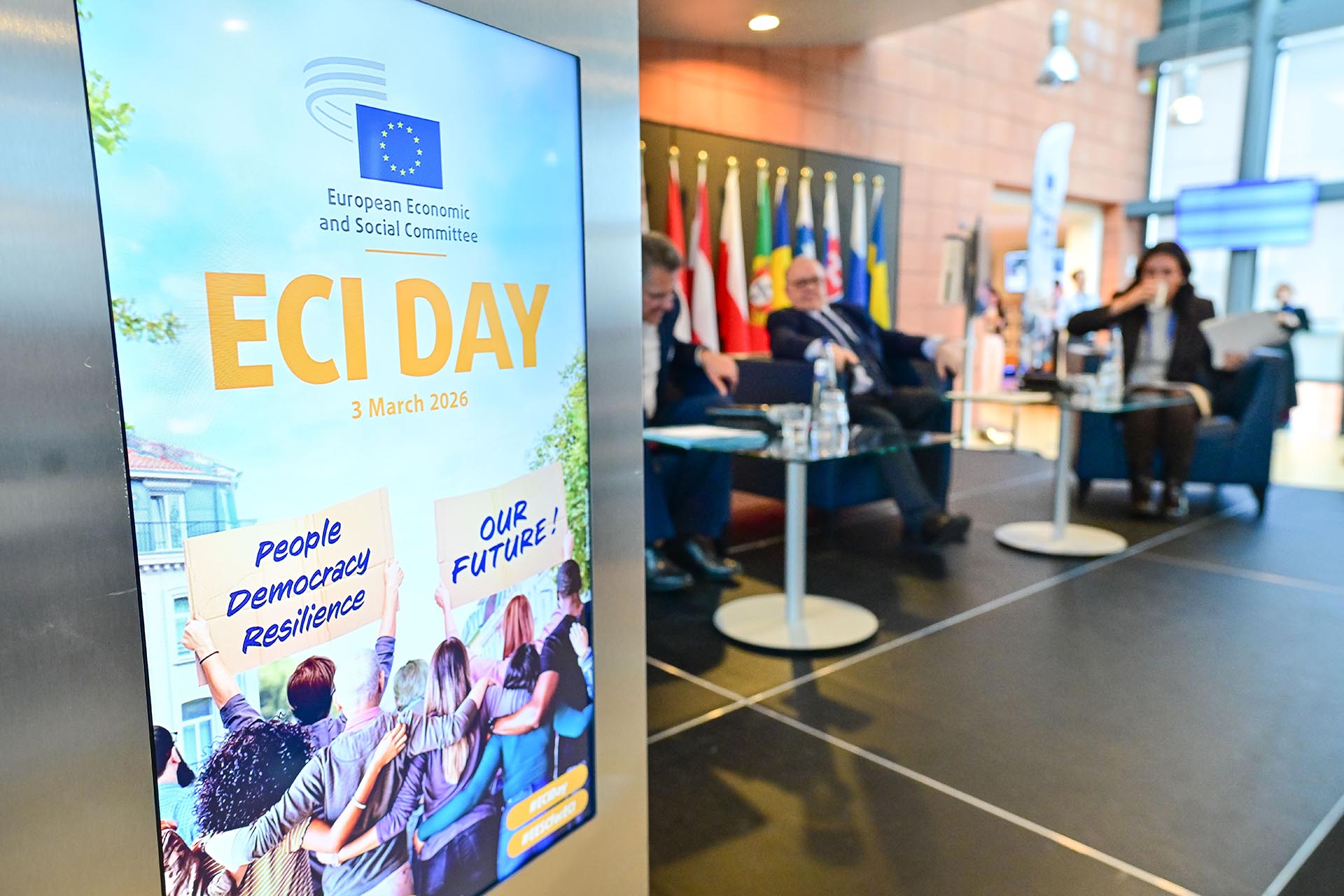
ECI Day 2026 took place on 3 March, only three days after the United States and Israel started an illegal war with Iran. Even if the war was not explicitly addressed in the programme, the alarming geopolitical context strongly marked the event, making the conversation on how to truly leverage the potential of this EU participatory instrument all the more critical and urgent.
The annual ECI Day, organised since 2012 by the European Economic and Social Committee in collaboration with The ECI Campaign and several other partners, is a place where different worlds meet: ECI campaigners from across Europe – sometimes with no or very limited EU political experience – meet the world of EU institutional politics.
Even if this edition of the ECI Day did not offer much opportunity for a direct confrontation between these two worlds – responsible ECI Commissioner Maroš Šefčovič only joined for the conclusion of the event, without Q&A opportunity – throughout the event it was palpable that the hopes and expectations that campaigners and citizens have of this instrument – and of the EU as a whole – are more often than not not being met.
The high-level opening session started with short presentations from the ongoing ECIs. Matteo Cadeddu kicked it off on behalf of the “My Voice, My Choice” ECI, reporting about the recent Commission Communication responding to their ECI. Despite the Commission’s refusal to set up the requested new fund, the Commission’s answer was nonetheless heralded as a “historic decision” by Matteo, “because they said officially that European funds can be used for improving access to safe abortion around the European Union.”
Subsequently, we heard from the two successful ECIs that are still waiting for answers from the Commission. Matteo Garguilo from the “Ban Conversion Practices” ECI expressed satisfaction with the public hearing that took place the day before, and they expressed hope for a positive reply from the Commission by 18 May 2026. Pavel Zálešák from the “Stop Destroying Videogames” ECI emphasised that they are not “anti-industry”, they are merely “pro-honesty”: “we want a world where developers keep dreaming, publishers keep profiting and players actually keep what they buy. Innovation should not come at the cost of consumer fairness.”
While each ECI presentation was met with applause, one ECI presentation clearly stood out and shifted the energy in the room. Tamam Abusalama, a Palestinian-Belgian communications and campaigns professional, born and raised in Jabalia Refugee Camp in the Gaza Strip, presented the “Justice for Palestine” ECI. Referring to the more than half a million signatures that were collected in less than two months, she concluded: “Each signature is a demand: end EU complicity, fully suspend the EU-Israel Association Agreement, uphold international law and build a Europe rooted in solidarity, human rights and international law.”
While each ECI is unique, everyone organising an ECI essentially expects the same thing: a fair chance at changing a political reality. It is the persistent gap between successful citizen mobilisation and meaningful political or legislative follow-up that led The ECI Campaign and CEPS (Centre for European Policy Studies) to organise the workshop “From Initiative to Implementation”. In his introduction, our Director Carsten Berg noted that the data on the impact of ECIs are sobering. While it is arguably too early to judge the follow-up of the “My Voice My Choice” campaign, he shared that all previous eleven successful ECI organisers have expressed disappointment with the follow-up of their initiatives, or the lack thereof. This is further reflected in ongoing institutional actions involving several of these successful ECIs: ECI “Stop Finning” and ECI “Fur Free Europe” have submitted complaints to the European Ombudsman regarding the handling of their follow-up, while the ECI “End the Cage Age” is now even pursuing legal action against the Commission in an effort to secure meaningful follow-up to its promised legislative action.
During the workshop, participants discussed concrete ideas to strengthen the impact of successful ECIs in view of the official 2027 review of how the ECI framework is used and applied in practice. Proposals ranged from increasing the visibility of successful ECIs and strengthening links with national parliaments — for example through hearings at national level or the involvement of national parliamentarians in European Parliament hearings — to improving accountability mechanisms. Most notably, several participants highlighted that without a more binding and structured follow-up — including a pre-legislative obligation for meaningful consultations and impact assessments — the impact of successful ECIs will remain limited. In addition, stronger political scrutiny by the European Parliament and other institutions was emphasised. Practical measures such as a standard press conference with the participation of the Commission President were also proposed to ensure greater transparency and accountability in the Commission’s response. Find our three main takeaways from the workshop here and the full list of ideas developed here.
In his concluding words, Commissioner Maroš Šefčovič attempted to reassure participants that the Commission pays close attention to ECIs, outlining ongoing follow-up activities and inviting stakeholders to contribute to the upcoming review of the ECI framework. In turn, Séamus Boland, President of the EESC, placed the discussion in a broader political context, warning that “the world in which we live today has become very dangerous.” While calling for renewed efforts in international diplomacy, he stressed that “civic engagement and participatory democracy has never been more important than it is today.”
For us, the discussions throughout ECI Day 2026 made one thing unmistakably clear: if the ECI is to live up to its promise in an increasingly volatile world, it must deliver real-world impact. Political will will not emerge on its own—it must be created. Civil society must bring transparency, contribute its expertise, hold institutions accountable, and drive the change needed to meet this moment.
Related news

ECI DAY
21.04.2026
From Initiative to Implementation: 3 Key Takeaways from Our ECI Day 2026 Workshop

ECI DAY
21.04.2026
ECI Day 2026 “From Initiative to Implementation” workshop outcomes: ideas & notes

ECI DAY
02.02.2026
Join this year’s ECI Day on 3 March in Brussels!
ECI DAY
10.04.2025
ECI Day 2025: Building Bridges Amidst Polarisation

ECI DAY
07.02.2025
Join this year’s ECI Day on 18 March in Brussels!
ECI DAY
12.03.2024