

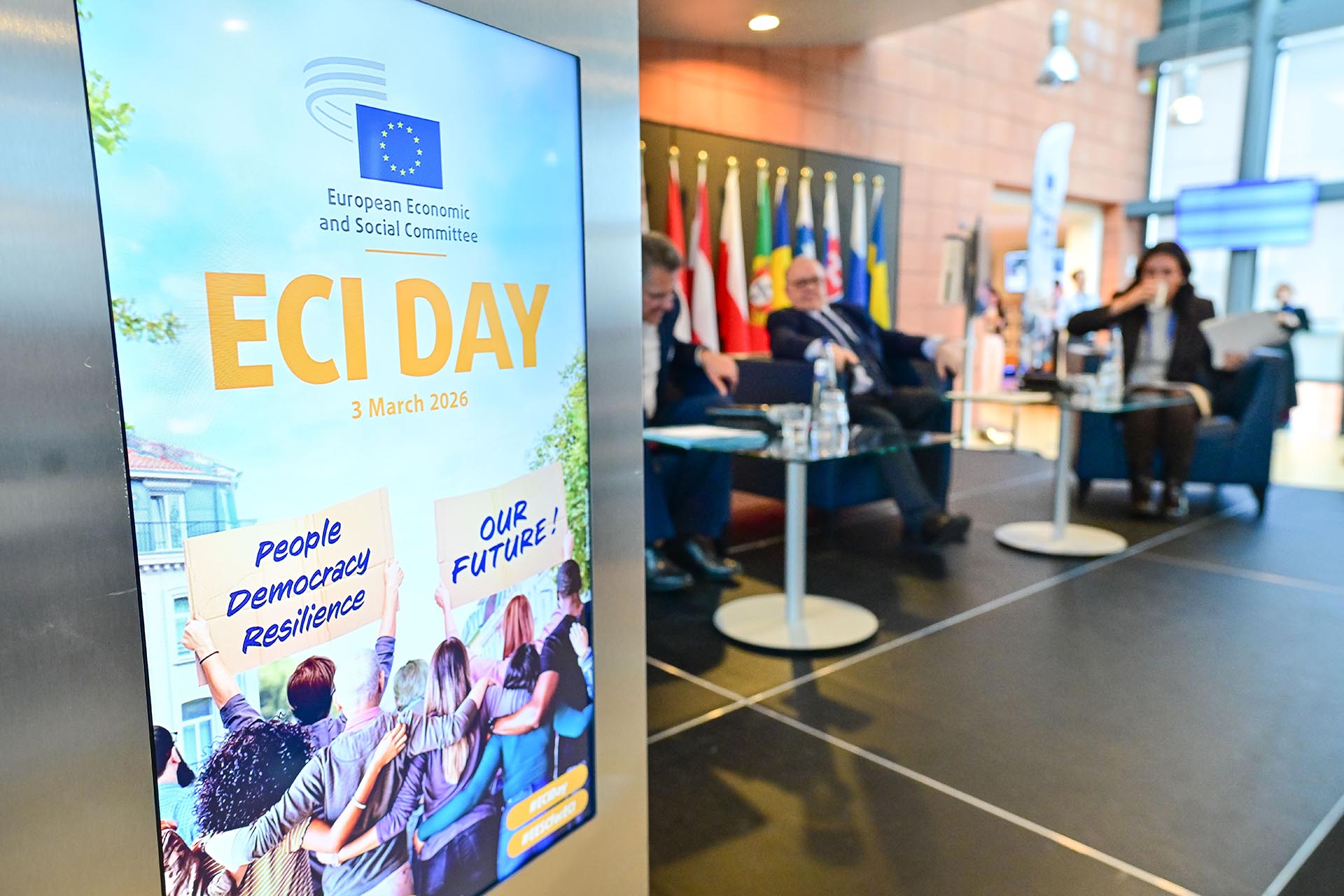
Image credits: EESC
ECI DAY
21.04.2026
As part of ECI Day 2026 that took place on 3 March, The ECI Campaign and CEPS (Centre for European Policy Studies) organised a 1-hour workshop with the title “From Initiative to Implementation”. Participants were working in ten different groups, developing concrete ideas on how to strengthen the impact and improve the follow-up of successful ECIs. Find the full list of ideas the groups developed here. Below we share our three main takeaways of the session based on ideas developed during the workshop.
1. There is a strong need for more accountability in the follow-up process of successful ECIs.
Numerous ideas were put forward to make the follow-up process for successful ECIs more accountable, introducing stronger checks and balances to ensure that every initiative reaching one million signatures has a fair and credible chance to shape policy and political outcomes.. On the one hand, there were ideas that suggest a number of additional steps or events in the follow-up to successful ECIs. One group called for a Commission press conference to accompany each official response to a successful ECI, involving both the responsible Commissioner and the Commission President—who, so far, has not publicly addressed any successful ECI. This would signal the priority given to the instrument and strengthen public awareness and scrutiny. Another group proposed making a structured exchange with organisers and stakeholders mandatory, requiring the Commission to carry out both a consultation and an impact assessment for each successful ECI. On the other hand, participants believed that other EU institutions could do more to pressure the Commission and hold it accountable vis-à-vis successful ECIs. In cases where the Commission has not or not yet committed to implementing the objectives of a successful ECI, the European Parliament could use its own “right of initiative” and develop a report outlining the action that it believes needs to be taken. Additionally, at the start of a new term it could use the appointment hearings to address questions to Commissioners-designate who happen to be former Commissioners responsible for the follow-up of specific successful ECIs. Other bodies – such as the Committee of the Regions and the European Economic and Social Committee – could also get more active in the follow-up of successful ECIs, so it was argued.
2. The ECI needs to be more strongly anchored at the national level.
Several ideas were developed aiming at anchoring the ECI more strongly at the national level, suggesting that this may lead to broader awareness about the instrument and more bottom-up pressure on the Commission and other EU institutions to take each successful ECI seriously. One group called for public hearings to be held on successful ECIs in national parliaments – involving also national civil society organisations and local politicians – while another group suggested involving national parliamentarians in the European Parliament hearings on successful ECIs. Furthermore, a group coined the idea for a yearly plan of events in the 27 Member States revolving around or building up to the annual ECI Day. Finally, the idea was coined to have the annual ECI Day organised outside of Brussels, across the European Union.
3. The campaigning capacity of (successful) ECI organisers needs to be improved.
Participants have made several suggestions related to improving the campaigning capacity of (successful) ECI organisers. One group called for extending the period during which (successful) ECI organisers can access and contact supporters via the Commission’s system, as campaigning typically continues well beyond the current three-year limit (after the Commission’s response). Another suggestion is to have a dedicated EU budget line for the ECI, including for educational and youth outreach, and one group also called for direct EU funding for ECI organisers. Although Art. 17 of the CERV programme regulation allows for such ECI funding, all applications submitted by ECI organisers to date have been rejected by the Commission. Finally, a recurring theme was the need for more spaces of networking and knowledge-sharing among organisers from different ECIs, whether this be during the ECI Day, online or in other formats.
Related news


ECI DAY
21.04.2026
ECI Day 2026: Can the ECI Deliver in Dangerous Times?

ECI DAY
21.04.2026
ECI Day 2026 “From Initiative to Implementation” workshop outcomes: ideas & notes

ECI DAY
02.02.2026
Join this year’s ECI Day on 3 March in Brussels!
ECI DAY
10.04.2025
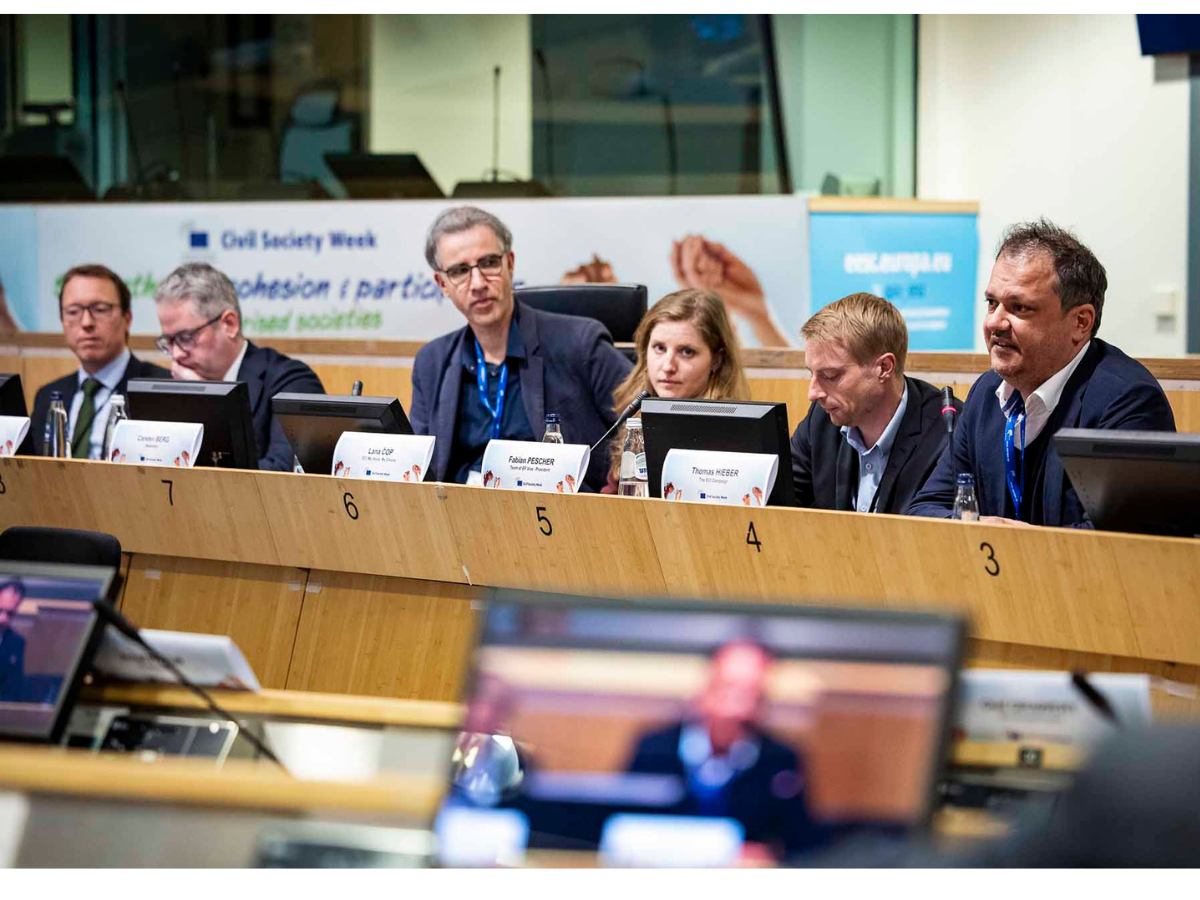
ECI Day 2025: Building Bridges Amidst Polarisation

ECI DAY
07.02.2025
Join this year’s ECI Day on 18 March in Brussels!
ECI DAY
12.03.2024